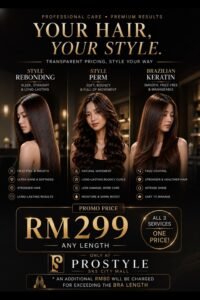
If humid mornings leave you reaching for straighteners before breakfast, rebonding can feel genuinely liberating. The chemical service restructures the hair to create a smoother, straighter finish that lasts until new growth appears. In Johor Bahru, prices vary widely: soft rebonding may start around RM200, while longer, denser or more specialised work can reach RM800 or more. The final figure depends on the technique, hair condition, product use and stylist’s time.
What You Are Paying For
Rebonding is a technical process, not simply a strong straightening cream. A stylist first checks your texture, elasticity and chemical history. A softening solution is applied to alter the hair’s internal bonds, followed by careful rinsing, drying and flat-ironing. A neutraliser then fixes the hair into its new shape before the finishing steps.
The appointment often lasts three to five hours. Precise application and temperature control matter because an uneven process can leave some areas resistant and others overworked. A reputable hair salon in JB charges for professional judgement as much as for the products used.
Typical Rebonding Price Ranges in Johor Bahru
Current salon menus show fringe rebonding from about RM150, soft or volume rebonding from around RM200, and C-curl or combined rebonding services from roughly RM360. Across the wider market, short hair may cost RM200–RM400, medium hair RM400–RM600 and long hair RM600–RM800. Corrective work or premium add-ons can take the total higher.
Treat these figures as planning guides. An online “from” price usually assumes a certain length, density and condition. Before agreeing, ask for a full quotation that states whether haircut, treatment, styling and aftercare products are included.
Traditional, Soft, Volume or C-Curl?
- Traditional rebonding: Produces a very sleek, pin-straight finish and may suit coarse, resistant hair.
- Soft rebonding: Keeps a little natural movement, making the result feel less rigid and more contemporary.
- Volume rebonding: Smooths frizz while avoiding an overly flat root area.
- C-curl rebonding: Combines straightness through the lengths with a polished inward bend at the ends.
- Fringe rebonding: Targets a smaller, hard-to-manage section and is therefore usually less expensive.
Soft, airy finishes are especially relevant in 2026. Clients still want easy mornings, but many prefer movement over the board-straight look associated with older techniques.
What Changes the Final Cost?
- Length and thickness: More hair means more solution, longer sectioning and additional ironing time.
- Texture and resistance: Coarse or tightly textured hair may require a different formula and closer monitoring.
- Previous services: Bleach, highlights, repeated colour or an old perm can make the process more complex.
- Hair condition: Porous or fragile areas may need pre-treatment, bond support or a gentler plan.
- Technique: C-curl, volume and combination services involve more shaping than basic straightening.
- Stylist expertise: An experienced technician may charge more, particularly for corrections or mixed textures.
Can Coloured or Bleached Hair Be Rebonded?
Sometimes, but not automatically. Permanent colour, bleach and rebonding all alter the fibre, so stacking them can increase dryness and breakage. A strand test can show whether the hair tolerates the proposed formula. If it stretches excessively, snaps or feels gummy when wet, postponing the service is the sensible decision.
Do not hide your colour history, even if the dye looks faded. Tell the stylist about box colour, highlights, henna, keratin treatments and previous straightening. Honest information helps them protect your hair and quote accurately.
How Long Does Rebonding Last?
The treated lengths remain straight, but your natural texture returns at the roots as hair grows. Many clients consider a touch-up after four to eight months, depending on growth rate and how noticeable the contrast becomes. Retouching only the new growth can limit repeated chemical exposure on already processed ends.
Humidity does not undo the structural change, although poor aftercare can make the surface look dry or frizzy. A smooth result still needs moisture, gentle handling and regular trims.
How to Prepare for Your Appointment
- Book a consultation: Share reference pictures and discuss how straight or natural you want the finish.
- Request a strand test: This is particularly important for coloured, fine or fragile hair.
- Confirm the total price: Ask about length surcharges, treatment, cut and senior-stylist fees.
- Set aside enough time: Rushing a technical service is never a worthwhile saving.
- Arrive with an honest history: List chemical services from at least the past two years.
Aftercare That Protects Your Investment
Follow your stylist’s waiting period before washing; recommendations can vary by formula. During the first few days, avoid tight ponytails, clips and tucking the hair sharply behind your ears, as these may leave bends. Once washing resumes, choose a gentle shampoo, nourishing conditioner and heat protectant.
Blot rather than scrub with a towel, and keep hot-tool temperatures moderate. A weekly moisture treatment may help, but heavy products can make fine hair limp. Your stylist can recommend a routine suited to your density and scalp.
Price Versus Value
A very cheap offer is not good value if it excludes essentials, uses an unsuitable formula or leads to costly repair. Compare consultations, stylist portfolios, hygiene, product transparency and recent reviews—not price alone. Ask whether the salon has experience with your texture and whether it can show healed results, not only freshly styled photographs.
If your budget is limited, discuss alternatives. A targeted fringe service, smoothing ritual or staged treatment may solve the daily problem without processing the entire head.
The Bottom Line
Budget roughly RM200–RM800 for rebonding in Johor Bahru, with smaller areas starting lower and advanced or long-hair services costing more. Your safest quote comes after a proper assessment. Choose a hair salon in JB that explains the process, checks compatibility and gives you realistic maintenance advice. The goal is not merely straighter hair on appointment day; it is a smooth, manageable result that continues to look healthy months later.